From connector to strategic advisor: how a technical project grows into a data partnership
Most data engagements start with a concrete question. A connection that needs to be built. An export that needs to be automated. Nothing strategic; just a technical problem that needs solving.
But the best partnerships emerge from exactly that moment. In the execution of that first, well-scoped project.
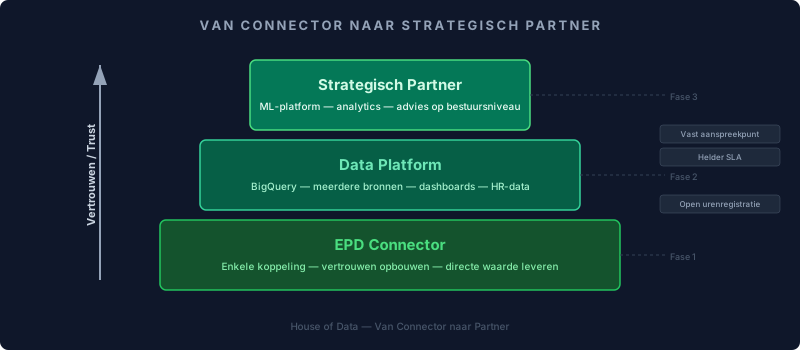
Phase 1: A single connection, maximum focus
At a healthcare institution, it started with an EHR connector. Data from the Electronic Health Record needed to flow into a data warehouse: structured, daily, reliable. No grand transformation programme. No thirty-page vision document. Simply: make sure this data is ready every morning.
That is deliberate. We believe trust does not start with a presentation, but with a working pipeline. When that connector runs for three months without incidents, when the data is there every morning at seven, something more fundamental has happened than a technical implementation. A foundation has been laid.
The lesson: start small. Deliver something that measurably works. Don’t talk about potential; demonstrate it.
Phase 2: From connector to platform
Once the foundation is in place, space opens up. The organisation sees that data can flow reliably. And then the questions come.
“Can we also unlock our HR data?” “Can we build a dashboard that combines operational and financial data?” “Can we make that BigQuery data available to other departments?”
This is the moment where a technical vendor faces a choice. You can treat every question as an isolated project: quote, deliver, invoice. Or you can invest in a broader data model that integrates multiple sources and enables the organisation to answer its own questions.
We consistently choose the latter. Not because it is altruistic, but because it produces better systems. An HR data source sitting alongside EHR data in the same warehouse opens possibilities that neither source offers in isolation. Staff absence alongside patient satisfaction. Staffing levels alongside treatment outcomes. That is no longer data engineering: that is business intelligence.
Phase 3: Strategic partner
The third phase is the most interesting, and the least obvious. A healthcare institution that trusts its data starts using data for decisions that go beyond reporting.
Think of an ML platform for prognostic patient profiles. Or predictive models for capacity planning. Or an integrated dashboard that enables the board to steer on data rather than intuition.
At that point, you are no longer a vendor. You have a seat at the table in strategic discussions. You help shape which data initiatives get priority. You advise on architecture decisions that commit the organisation for years.
That is not scope creep. It is the logical consequence of a relationship where both parties invest.
What makes this possible
The transition from connector to strategic partner does not happen by itself. There are concrete prerequisites.
A dedicated point of contact. Not a rotating project team, but a person who knows the organisation, knows the data, and understands the context. Someone who knows that “the EHR data looks different since last week” means there was a system update, not that the pipeline is failing.
A clear SLA. Not as a legal document, but as a shared expectation. What is the uptime? What are the response times? What happens during incidents? Transparency on this prevents frustration and builds trust.
Transparent time accounting. In healthcare, budgets are tight. Every euro must be justified. We work with open time registration: the client sees exactly what time is spent on. No surprises on the invoice. It sounds basic, but it is one of the strongest trust builders there is.
The broader ambition
A successful data partnership in healthcare is more than a reference on a website. It is a model that transfers.
Rehabilitation clinics, mental health institutions, hospitals: they all struggle with the same challenges. How do we unlock our EHR data? How do we combine clinical and operational data? How do we take the step towards predictive analytics?
The answers are not identical, but the patterns are. An organisation that has successfully walked this path is the best proof that it can be done. And the best starting point for the next one.
That is why we invest in knowledge sharing beyond our direct engagements. Presentations at healthcare conferences. Conversations with data specialists in the sector. Not to sell, but to have the discussion that needs having: how do we make the healthcare sector data-mature, step by step?
The bottom line
The path from connector to strategic partner is not a sales strategy. It is a conviction. Technical excellence is the entry point. Reliability is the foundation. And the willingness to think beyond the original assignment: that is what distinguishes a vendor from a partner.
Start small. Deliver quality. And let the partnership grow on the basis of proven value.