Google Cloud or Azure? The wrong question for your data strategy
“Should we go with Google Cloud or Azure?”
My answer is always the same: it is the wrong question. Not because it does not matter. It absolutely matters. But the question implies an either-or choice, and that is rarely how it works in practice.
Why the comparison is misleading
There are dozens of articles comparing Google Cloud and Azure feature-by-feature. Columns with checkmarks, comparison tables, “Azure has X but GCP has Y.” Those articles are useless for a business decision.
Why? Because the choice does not depend on features. Both platforms have more than enough of those. The choice depends on three things:
- What ecosystem do you already have? Does your organisation run on Microsoft 365, Dynamics 365, Power BI? Or are you platform-independent?
- What is the nature of your data workload? Operational reporting from an ERP, or data-intensive analytics and ML?
- Who manages it? Does the platform match the knowledge and capacity of your team?
Those three questions matter more than any feature comparison.
Google Cloud: the powerhouse for data-intensive analytics
Our team has worked with both platforms for years, and there are areas where Google Cloud is clearly stronger.
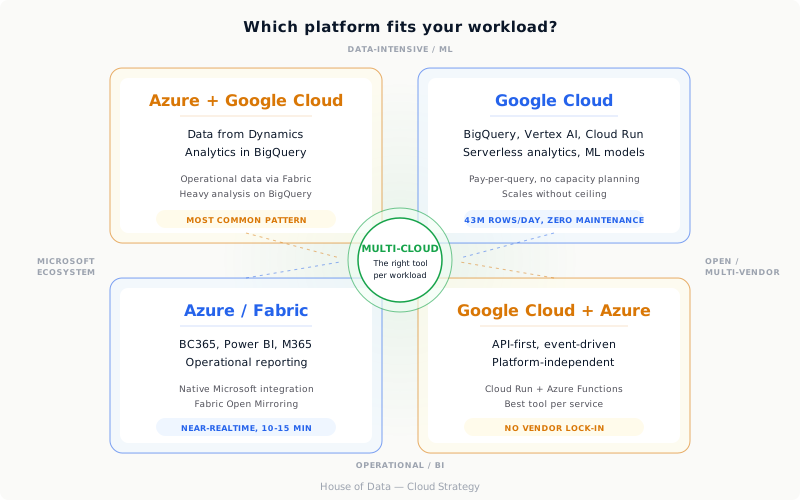
BigQuery is the best example. Serverless, no capacity planning, scales without you having to do anything. We built a healthcare analytics platform processing 43 million rows per day through it. No nightly maintenance jobs, no reindexing, no scaling up. Data in, queries on it, done.
Data engineering. Dataflow for streaming, Pub/Sub for event-driven architectures, Cloud Run Jobs for batch processing. The tooling is built for data-intensive work and you notice that in daily practice. Less configuration, less maintenance.
ML and AI. Vertex AI and BigQuery ML allow you to apply machine learning directly on your data without moving it to a separate ML platform. For organisations that want to build predictive models on their own data, that is a major advantage.
Cost transparency. BigQuery operates on a pay-per-query model. You pay for what you use, not for reserved capacity. That makes it easier to predict and control costs.
Azure: the natural habitat for the Microsoft ecosystem
Azure is not “worse” than Google Cloud. In certain scenarios it is the better choice.
Microsoft ecosystem. If your organisation runs on Microsoft 365, Dynamics 365 Business Central and Power BI, then Azure is the logical extension. The integration is native: data from BC365 flows through Fabric directly to Power BI without needing complex pipelines.
Fabric Open Mirroring. We manage a data platform for a manufacturing company where data from Business Central flows near-realtime to Fabric with 10-15 minute latency. No Synapse pipelines, no staging tables. For organisations already in the Microsoft ecosystem, that is a powerful combination.
Enterprise compliance. Active Directory, Conditional Access, EU Data Boundary: for organisations with strict compliance requirements Azure offers an integrated package that fits well with existing governance.
However. Azure can turn out significantly more expensive than expected with I/O-intensive workloads. We experienced a situation where a lift-and-shift to Azure caused costs to explode for near-realtime reporting. On-premise, turning on the tap is free; in the cloud you pay per drop. Without rearchitecting your data layer, the cloud becomes a bottomless pit rather than a saving.
The reality is Google Cloud & Azure
The either-or framing is a vendor narrative. Microsoft wants you to put everything in Azure. Google wants you to put everything in GCP. Both logical from their perspective, but it is not in your interest.
The reality for most organisations we work with: they already use both platforms. Microsoft 365 runs at nearly every company. And as soon as you start doing data-intensive work (analytics, ML, large datasets) Google Cloud enters the picture.
The pattern we see most often:
- Operational data via Azure/Fabric for BI reporting. Data from Dynamics, from Microsoft 365, Power BI dashboards for management.
- Analytical and ML workloads on Google Cloud/BigQuery for heavy analysis, predictive models and data engineering. Where Fabric excels at integration, BigQuery delivers the compute power for complex models where Microsoft’s “all-in-one” solution hits its limits.
That is not a compromise. That is the right tool for the right job.
Three questions for your cloud strategy
When you face this choice, do not ask “which platform is better?” but:
1. What ecosystem do you already have? Are you deeply invested in Microsoft? Then Azure is your starting point for operational data. Are you platform-independent or do you already have GCP experience? Then there is no point pulling in the Microsoft ecosystem just for data.
2. What is the nature of your data workload? Operational BI from an ERP belongs with Azure/Fabric. Data-intensive analytics, ML models, serverless processing of large datasets: that is what BigQuery is built for. It is not a matter of better or worse, it is a matter of fit.
3. Who manages it? A platform that does not match your team’s knowledge only creates dependency. Choose the platform your people (or your partner) know best for the workload in question.
Not choosing, but assigning
The question is not Google Cloud or Azure. The question is: which workload belongs where? And who helps you answer that based on experience, not based on a partnership with one of the two?
We work with both platforms. Not because we lack an opinion, but because our clients benefit when we pick the right tool per situation. That is the difference between a vendor and a partner.
Have a specific data challenge? Schedule an initial consultation with us. No sales pitch, just a substantive conversation about what fits your situation.
Frequently asked questions
- What is the biggest difference between Google Cloud and Azure for SMEs?
- Ecosystem, not features. Running Microsoft 365/Dynamics/Power BI? Azure is logical for operational data. Have data-intensive or ML workloads? BigQuery offers a stronger foundation. Most SMEs benefit from using both.
- Can I use Power BI on Google Cloud?
- Yes, via the BigQuery ODBC connector. Prefer staying fully in the Google ecosystem? Looker is the alternative. In practice we often see a combination: Power BI for operational dashboards, BigQuery for heavy analysis.
- What about GDPR when migrating to the cloud?
- Both platforms offer EU-region storage and encryption. Compliance is not about platform choice but configuration: where is your data, who has access, how is that documented? Set this up per project.
- What are the hidden costs of cloud migrations?
- Data egress, idle compute and lack of monitoring. A lift-and-shift without rearchitecting your data layer does not deliver savings, just a higher bill.
- Why a strategic partner rather than just buying licences?
- Tools are not results. The difference lies in translation to your situation: which workload belongs where, how do you avoid lock-in, who watches costs? A partner who understands your business saves more than the investment costs.