
De-escalating in a meeting: not always by pushing harder at the table
A working session of ninety minutes. Three parties at the table: the supplier, an internal adviser, a change adviser. Four open architecture questions on the agenda.
The supplier opened with a reframing: not just the connection route is open, the broader architecture choice is too. The internal adviser sided with him. A colleague challenged a frame I had set earlier with a pointed question. If this is not an architecture question, are we not running the risk that someone else will end up deciding this?
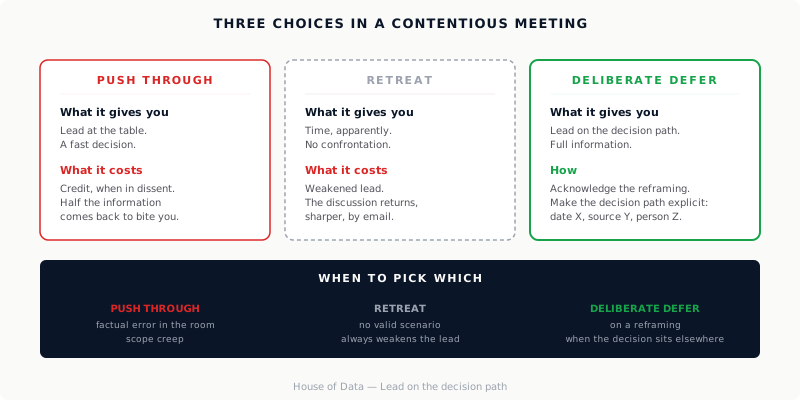
At that moment, you can do three things. Push through to a decision, retreat into uncertainty, or deliberately defer. I chose the third.
What pushing through would have cost
Pushing through, in this constellation, was tactically tempting. Forcing a decision at the table would have given me back the lead. But it would also have undermined something harder to repair: the authority to force a bigger decision the next time around.
Three reasons why pushing through would have been wrong here.
Dissent at the table. Two subject-matter experts disagreed with my frame. A PM who pushes through in that situation signals that he prefers winning the outcome over having the conversation. That costs credit.
Incomplete facts. The supplier wanted his architect to talk to ours. Making a call without that conversation is making a call on half the information. At a formal decision later, that comes back.
A decision moment already scheduled elsewhere. The steering committee was set to decide two weeks out. A decision at this table would have put the steering committee in front of a fait accompli. That is overruling an informal mandate, and you can do that once before you are out of credit.
What I did instead
I reframed the meeting. The architecture question is open, but the decision lands formally elsewhere. Until then, the supplier keeps working on the variants most likely to go through. The internal adviser and I have a separate conversation about the authority frame, away from this meeting. The architects on both sides talk to each other before the steering moment.
A deferred decision, but not a weakened lead. The order was: acknowledge, reframe, follow-up. Not yes or no, but a structured path to the decision.
Three rules that work for me
Acknowledge a reframing out loud. Pushing it aside is not safe. Anyone who leaves something unsaid in a room of people knows it will come back later in an email, with a sharper tone. Acknowledge the observation, even if you disagree with it.
Make the decision path explicit. Not “we’ll decide later” but “we decide on date X, against source Y, after consulting person Z.” That turns deferral from weakness into lead.
Close with an action recap, not with a personal round. Leader mode ends a meeting with who does what and when. Consultant mode ends with thank-yous. Both are legitimate, but they send different signals. In contentious meetings: leader mode.
When pushing through is right
De-escalation is not a reflex. Sometimes it is genuinely wrong. If a supplier pushes scope creep under the banner of new insights, you have to push back. If a colleague repeats a factual mistake, you have to correct it. If the steering committee will decide next week on false assumptions, you cannot wait to expose those assumptions.
The difference is in what is at stake. With a reframing: buy time. With a factual error: correct now. With scope creep: block now.
Lead on the path, not on the outcome
After the meeting, a colleague said: it was smart that you moved the decision to Monday. In the moment, it almost felt like retreating. A day later, I realized it was the opposite. Taking the lead by dictating the rhythm, instead of dictating the outcome.
De-escalating in a meeting is not weakness. It is a choice to lead on the decision path instead of on the outcome. Anyone who can draw that line builds the authority for the moments when pushing through is the right move.
Related articles
-
Fixed budget, flexible scope: what do you do when 27% is spent and you have nine weeks left?
Halfway through an MDM engagement. Budget partly consumed, more than half the timeline gone, and the scope still not fixed. No crisis, but the moment to switch gears.
-
Hypercare is no longer a project: the transition from go-live to run in practice
A go-live with 124 open items sounds like a failure. It is exactly the opposite. Hypercare is not an extension of the project. It is its own phase, with its own rules.
-
Digital transformation without mandate: how to reach the decision-maker
Being technically right is not enough. The art is understanding who decides and how to reach that person.