
Fixed budget, flexible scope: what do you do when 27% is spent and you have nine weeks left?
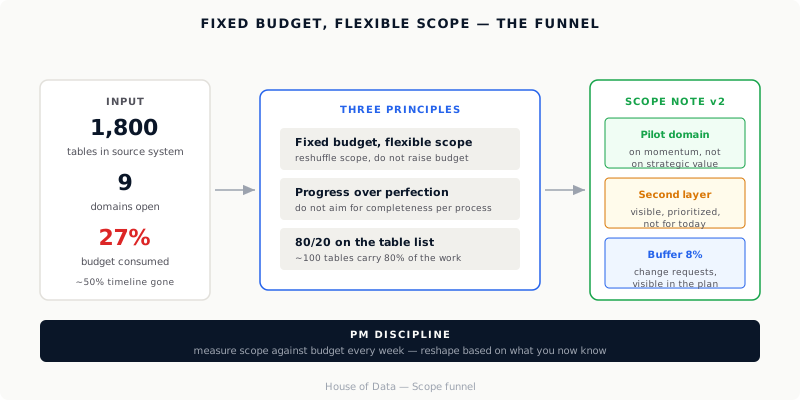
Halfway through an MDM engagement, I found myself in this situation. Budget partly consumed, more than half the timeline gone, and the scope still not fixed. No crisis. But the moment to switch gears, hard.
The situation in numbers
A Statement of Work for a Master Data Management Phase 1 was based on fixed budget and flexible scope. Nine weeks after the official start, 27% of the budget had been consumed. A bit more under the hood, because some hours had been booked to a holding code and still needed to be allocated to SoW activities. On timeline, the counter stood at roughly halfway.
The first milestone slipped. The second workshop with the Data Owners was not yet planned. The scope document was still a draft from a few weeks back. The team was working hard, but the direction was diffuse.
Three principles to start with
The engagement codified what we already knew, but had not yet said out loud.
Fixed budget, flexible scope. It is in the SoW. It means we reshuffle scope within the budget, not that we ask for more budget because the scope turned out larger than we thought. This principle only works if you are willing to actually cut scope.
Progress over perfection. Don’t aim for completeness per process. Ten work instructions and ten data quality rules per process is already a substantial step. The product owner had used those exact words in the first real steering call, and it turned out to be the sharpest grip we had.
80/20 on the long table list. Eighteen hundred tables in the source system, around one hundred carry 80% of the work. Start there.
The funnel
With these three principles in hand, we wrote a Scope Note v2 that made explicit what was in and what was out. We picked a pilot domain based on momentum, not on strategic importance. The domain where the approval flow was already in design, and where a steward had already been put forward. Pilots run on momentum, not on argument.
For the remaining domains, a second layer was added to the scope baseline: visible, prioritized, but not for today. That is the craft. Not hiding them, but also not starting on them yet.
When we showed the Scope Note v2 to the product owner for the first time, it carried a sentence she had once used herself: progress over perfection. She paused, and said: this is exactly what I meant, but I hadn’t written it down like that. From that moment, we shared a common language.
Where it becomes a PM discipline
Fixed budget with flexible scope is often sold as the comfortable option for the client. For a PM, it is the harder variant. You have to measure each week whether the scope is on track within the budget, and reshuffle when needed. That is not the same as reporting progress. It is reorganizing based on what you know now.
A few concrete things that helped:
- Earmarking a buffer of around 8% of the budget for unforeseen items and new change requests, visible in the plan.
- For every change, a short CR with scope impact and hours impact, so decisions remain traceable.
- A weekly 30-minute call with the sponsor on budget and scope, separate from the content-level progress.
What I would not do
Avoid the budget conversation until the final report. The client experiences that as a notification, not a choice. A sponsor wants to be taken along in the reshuffling, not held to account for it afterwards.
Or leave the scope as it was and hope the team will speed up. Speeding up on an unclear scope leads to busyness without movement. First the funnel, then the speed.
Not the soft option
Fixed budget with flexible scope is not the soft option in project governance. It is a PM discipline that asks you, every week, to reshuffle based on what you now know. Anyone unwilling to do that ends up writing a final report whose main message is that the budget has run out.
The decision to funnel early is rarely the difficult choice in hindsight. The difficult choice is funnelling while the team is still working with full conviction inside the old scope. That is where the PM work sits.
Related articles
-
De-escalating in a meeting: not always by pushing harder at the table
A supplier reframes the architecture in public. A colleague challenges your authority. Three participants look at you. Push through, retreat, or deliberately defer?
-
Hypercare is no longer a project: the transition from go-live to run in practice
A go-live with 124 open items sounds like a failure. It is exactly the opposite. Hypercare is not an extension of the project. It is its own phase, with its own rules.
-
The hidden costs of outsourced integrations: why owning your data layer matters
Every time an external partner manages your data architecture, you give up control. Sometimes rightly so. But do you always know what you're giving up?